Showing posts with label *Basics. Show all posts

Friday, August 26, 2016

UKULELE LOVE

I LOVE strings! -- violins, guitars, violas, dulcimers, cellos, mandolins, basses, harps, banjos, and UKULELES. During my career as a musician and music educator, I've grown to appreciate the ukulele because of the simple pleasures and hands-on learning it provides. The ukulele is a rhythmic, harmonic, and melodic instrument that inspires joyful music making.

Over the years, I've collected and created a folk repertoire for teaching ukulele, based on a natural learning sequence and common patterns. Whether you're a teacher or student, I hope you find this site useful and enjoyable. This is my online offering to parents, children, self-starters and music educators. 


All material on this site is protected by an international Creative Commons Attribution-NonCommercial-NoDerivs 4.0 License.This means that if you use my materials in other than home or classroom settings, credit must be given for my work. Commercial use is not allowed, and you may not claim any part of this work as your own nor alter it. My logo/blog URL should be included on copies you make or share:  http://youukulelenotes.blogspot.com/. 
(CC BY-NC-ND 3.0)
Click on the tabs in the top menu bar to explore resources by keys, concepts, and levels. Use my Index and Teaching Sequence to guide the learning/teaching process. You may click on the embedded pages to enlarge them for projection or printing. Enjoy!

             ~ Jeri     

Friday, August 12, 2016

From Folk to Fantastic

Ukes can take us 

In recent years, ukuleles have become very popular. 
Ukes are now appreciated as much more than a simple 
folk or beginner's instrument, thanks to artists such as these: 


                                                 Elvis Presley                          'Iz" - Israel Kamakawiwo'ole                  Jake Shimabukuro
                                                                                            Somewhere Over the Rainbow                 While My Guitar Gently Weeps                


                                                                                  The Ukulele Orchestra of Great Britain          
                                                                               Concert Performance of James Bond Theme  


Wednesday, August 10, 2016

'Youke' Can Tune

Soprano, Concert and Tenor ukuleles are tuned to these notes:


Here's a little ditty I wrote (based on "My dog has fleas") to help students solidify the tuning pitches in their ears. Sing it first and then pluck strings on "my dog has fleas" as you sing. A teacher may add the optional chordal accompaniment.


Here are some links to great online ukulele tuners: 
YouTube Ukulele Tuner 1    
YouTube Uke Tuner 2  
https://ukutuner.com/     
Pineapple Pete's Uke Tuner

Tuesday, August 9, 2016

Ukulele Playing Position


'Youke' Can Have Excellent
Posture & Technique

      Sit straight and forward on your seat (or stand).
      Right arm cradles the uke against your ribs.
      Right arm is generally parallel to the neck.

      Left arm is relaxed and slightly away from body. 
      Left hand comes forward @ 90 degrees.
      Left  palm faces upward.
      Fingers curve as if holding a baseball.   
      Thumb rests against back of the neck.


      Left fingers bend toward the fingerboard.   
      Fingertips press the strings against the  
           fingerboard just behind frets:
           first finger in the first space,
           second finger in the second space,
           and third finger in the third space.

    
      Strum downward (to begin) with the side 
            of your thumb or the back (nail) of   
            your index finger (a built-in pick). 
      Strum near the point where the neck joins the body.


Holding the Ukulele - Video by Bernadette Teaches Music

Monday, August 8, 2016

Ukulele Notes on the Staff and Fretboard

This chart is a useful reference when finding singing pitches or figuring out tunes or chords on your own.

The Chromatic (all colors) Fingerboard

"Chromatic" means all colors. The chromatic scale uses all twelve half-steps in the western music system. Frets are placed in the fingerboard one half-step apart. The sharp and flat signs indicate that a note has two names. For example, the note between C and D is called C-sharp (up one half-step from C) in some keys/chords, and D-flat (down one half-step from D) in others.

Favorite Strum Patterns


Sunday, August 7, 2016

How to Read Ukulele Tablature (TAB)

You will find this chart helpful in understanding and reading ukulele tablature. With your ukulele in playing position, turn it over so the strings are facing you. Visualize each string as a TAB line. Try playing a short melody while reading TAB and holding your ukulele this way. Are you better able to read TAB now? Then it's time to hold your ukulele the correct way! 


There are many simple TABs in my melodies folder on this site. Check them out! When reading a melody in TAB, try switching back and forth between staff notation and TAB to build skills in both types of notation.

Sunday, July 10, 2016

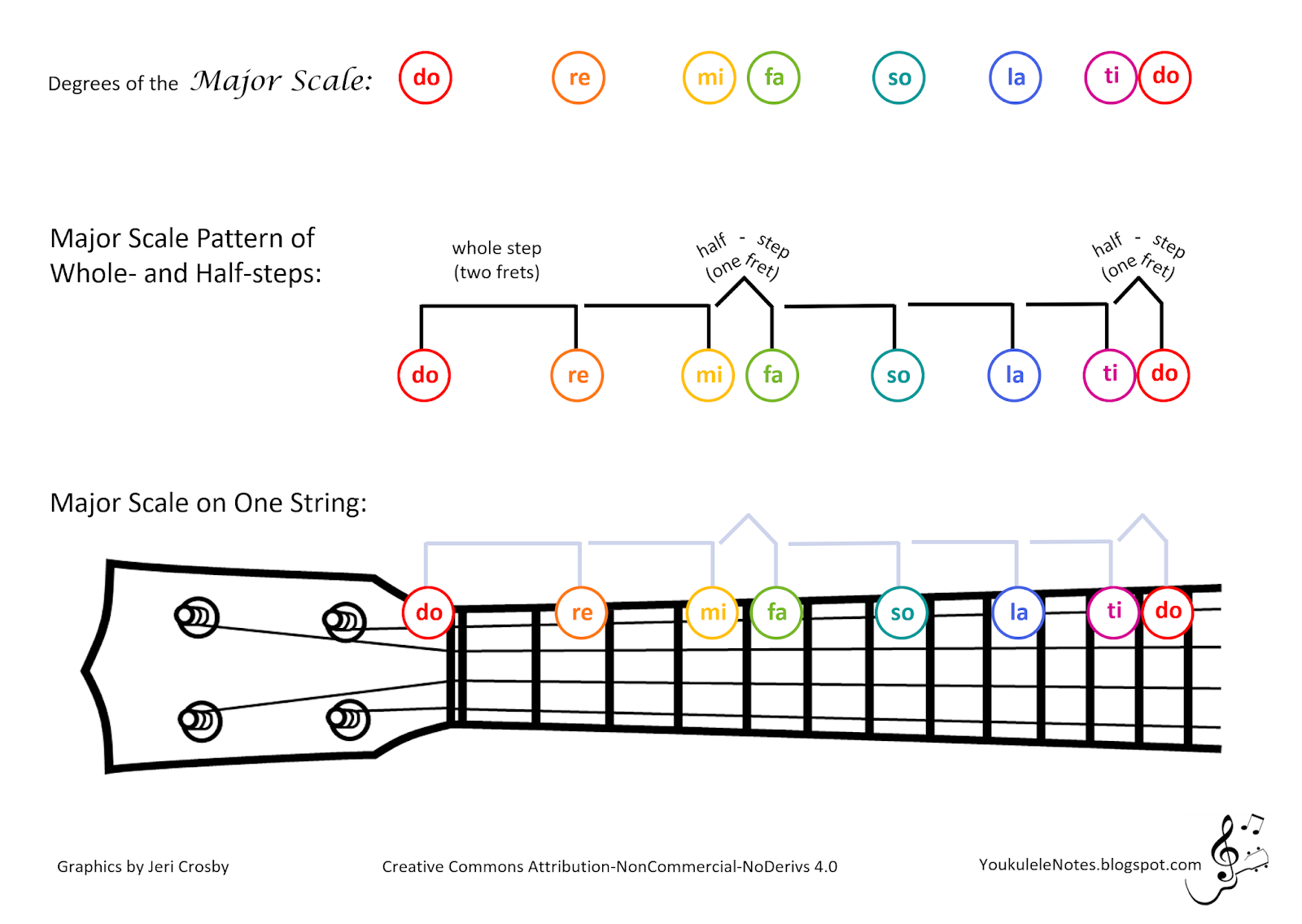
Major Scale Pattern

This is the universal pattern for a major scale. 
'Youke' can play a major scale beginning on any note by following this whole- and half-step pattern.


Saturday, July 9, 2016

Minor Scale Pattern

This is the universal pattern for a minor scale. 

'Youke' can discover a minor scale by starting on any note and following this whole- and half-step pattern. 

Compare and contrast the minor scale to the major scale pattern.
Note: This is the natural minor scale. To create a harmonic minor scale, which sounds a bit more mysterious or tense, raise (sharp) the seventh note  a half-step (change so to si).


You get to use your fourth finger in the fourth fret for A-flat.


Friday, July 8, 2016

U-Bass Bass-ics: Bass Ukulele

Adding a U-Bass to a ukulele ensemble adds harmonic and rhythmic interest. Use the chart below to visualize the notes on the bass ukulele.  

The bass ukulele is tuned differently than other ukes; it is tuned like a string bass or bass guitar: E A D G (from the thickest to thinnest string). Smaller bass ukuleles are tuned an octave higher than indicated in the chart below, but the note names are the same. 

The U-bass strings are a perfect fourth (four scale degrees) apart, which makes it easy to create bass patterns based on the bottom note and top note of any triad (first and fifth of any scale).

The simplest way to add bass accompaniment is to play the root (note name) of the chord on the first note of each measure (group of beats). One can also create a more interesting rhythmic pattern using this note. 

A more interesting way to create bass accompaniment is to alternate between the bottom note and the top note of a triad. (Triad: three-note chord structure that uses the first, third, and fifth degrees of a scale, e.g., root, skip, skip: A C E or C E G.) 

For example, bass back-up for a C chord uses C (root of triad, first note of C scale) 
                                                                    and G (top of triad, fifth note of C scale). 

And bass back-up for an F chord uses the root, F (first, main note)
                                                                     and C (alternating with F). 

The second, alternating note may be played higher than or lower than the main/root note. Often when the alternating note is played lower than the root, it will be in the same fret as the first note but on a neighboring string. Have fun adding bass notes to your ensemble!

Notice that the colors on my ukulele charts match other color-coded instruments such as Boomwhackers. If a U-bass ins't available, create bass accompaniment with Boomwhackers or homemade boom pipes. 

Blues Scale Pattern

This is the pattern for the BLUES scale. 

You can start on any note, and by following the interval pattern (spaces between notes), you'll have the 'blues!' 

Compare and contrast the blues scale to the minor scale.

Usually, scales are played across strings (not on just one string). 
Read the tablature (TAB) line and play this C blues scale. 
Next, sing the note names, reading from the staff. 
Then practice reading the scale from the staff.


Improvise using notes from the C blues scale and play along with this B.B. King Style Back-up Track from MyDarnJamTracks on YouTube. At first, only play open C and first and third frets on the E and A strings. Then jazz things up with the 'blue note,' F# (2nd fret on E string). Search for other blues back-up tracks in the key of C. Have fun!